PostgreSQL for MySQL Developers: A Practical Guide to the Differences
The PostgreSQL concepts, syntax changes, and production details MySQL developers need to know.
If you've spent years working with MySQL, PostgreSQL doesn't feel like a completely different database.
The SQL is familiar. Your application architecture can remain familiar. Most basic queries look familiar.
The surprises come from the details.
PostgreSQL is stricter about types and identifier handling, uses different syntax for several everyday operations, and exposes database capabilities that don't have direct MySQL equivalents.
A few examples:
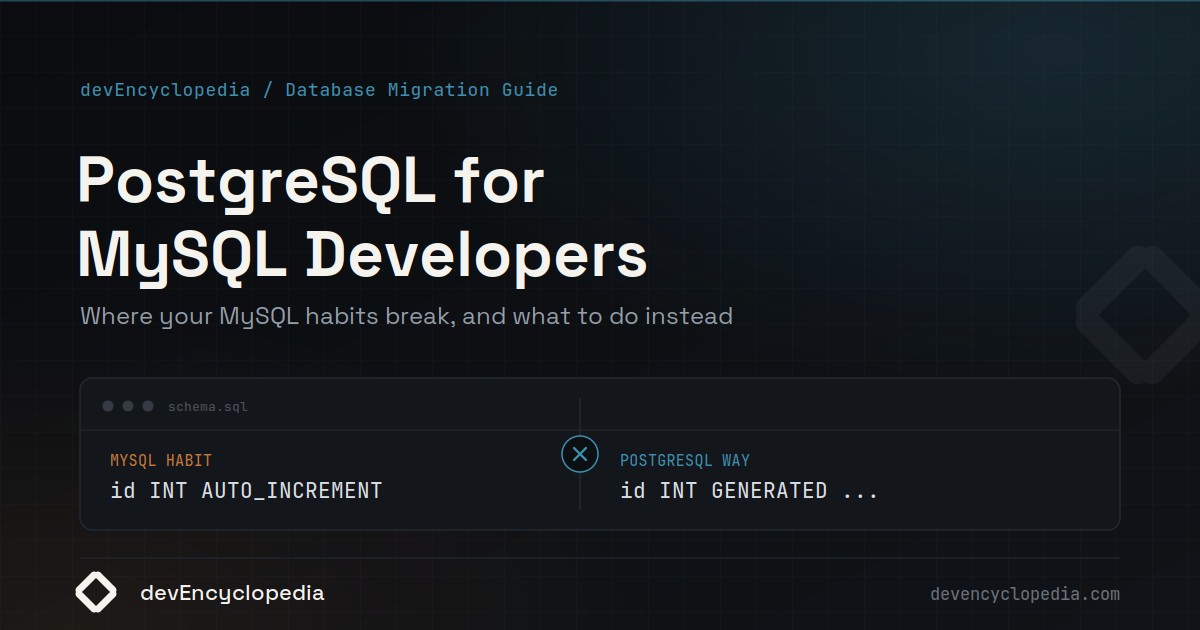
AUTO_INCREMENTbecomes an identity column orSERIALON DUPLICATE KEY UPDATEbecomesON CONFLICTLIKEandILIKEhave different semanticsTINYINT(1)is commonly replaced by a realBOOLEANJSONBprovides indexed document storage with operators that go beyond basic JSON extractionPartial and expression indexes allow much more targeted indexing strategies
DDL can participate in transactions
PostgreSQL's connection model makes pooling an important production consideration
The more interesting part is that not every migration problem produces an error.
A query can execute successfully and still behave differently.
Case-insensitive searches are one example. MySQL's default collation can make LIKE behave differently from PostgreSQL, where LIKE is case-sensitive and ILIKE is the explicit case-insensitive option.
There are also operational differences worth understanding before production. PostgreSQL's MVCC implementation creates dead tuples that autovacuum needs to reclaim. Large production indexes may require CREATE INDEX CONCURRENTLY. Applications using stricter isolation levels may need retry logic.
And then there are the PostgreSQL features that can change how you design your application, such as JSONB with GIN indexes, native arrays, row-level security, partial indexes, and transactional schema changes.
The goal of this guide isn't to declare one database better than the other. It's to give MySQL developers a practical map of what changes when they start writing PostgreSQL.
The full article walks through the syntax, data types, query differences, indexing strategies, transactions, production gotchas, and includes a MySQL-to-PostgreSQL quick-reference cheat sheet.
Read the complete guide here:
https://devencyclopedia.com/blog/postgresql-for-mysql-developers